
Using All the Tools in the Geotechnical Tool Bag
Site History
Located on the shore of the Long Island Sound in Bridgeport, Connecticut, the SteelPointe Harbor Redevelopment project is a four story 420,000 square foot mixed-use development that includes multi-family residential, retail, restaurant, fitness, and outdoor courtyard and pool areas.
The site was previously occupied by a United Illuminating power plant. The superstructure of the plant was demolished in 1985, but multiple subsurface features including foundations, slabs, and intake/discharge tunnels were abandoned in-place.
Geotechnical Challenges & Stalled Development
GEODesign has been involved in various capacities with the attempted redevelopment of the site through multiple design iterations since 1998. However, the site’s numerous subsurface challenges led to several stalled development attempts. Geotechnical issues of primary concern included:
- A variable soil profile across the site including areas of thick non-engineered fill soils and compressible organic silts.
- Remaining subsurface structures associated with the former power plant, with the full extents of these features being unknown.
- Abandoned, unfilled tunnels that were left in-place below the water table beneath proposed structure locations.
- Zones of contaminated soil and groundwater resulting from former power plant operations.
Hybrid Foundation Design Leads to Construction
In 2021, Flaherty & Collins Properties retained GEODesign to develop a cost-effective foundation design to address the numerous geotechnical challenges and minimize the need for costly off-site disposal of environmentally impacted soils.
We developed an approach that included a hybrid foundation system consisting of conventional spread footings where practical, ground improvement for most areas where excavation and replacement of unsuitable or contaminated soils would have been excessively costly, and driven piles in limited locations where ground improvement was deemed not feasible.
Our recommended approach with respect to remaining structural elements associated with the former power plant was to remove abandoned structures to the extents practical, and provide enhanced subsurface evaluation and/or remedial efforts where removal of subsurface structures was impractical. This ultimately included:
- Additional explorations adjacent to or through abandoned features to remain in place to verify the suitability of bearing materials;
- A program to properly abandon tunnels located below the water table in-place with flowable fill; and,
- Crushing removed structures onsite and recycling the crushed concrete for use as backfill material in select locations.

Construction and Ongoing Value Engineering
Construction began on the project in 2024 with GEODesign continuing to provide ongoing construction inspection. When unexpected site conditions were encountered such as encountering previously unknown structural elements or unfavorable subsurface conditions in areas where subsurface explorations data was limited, GEODesign provided value-engineering recommendations to minimize impact on the project schedule while limiting additional project costs to the extent practical. Among other items, our construction phase value engineering included:
- Evaluating previously unknown subsurface structures for their ability to remain abandoned in place;
- Identifying areas where unsuitable soils excavated during foundation construction could be reused onsite rather than disposed of; and,
- Developing updated driving criteria for pile supported areas to limit pile lengths based on each pile cap’s individual capacity requirements and the results of a recently completed static and dynamic pile load testing program.
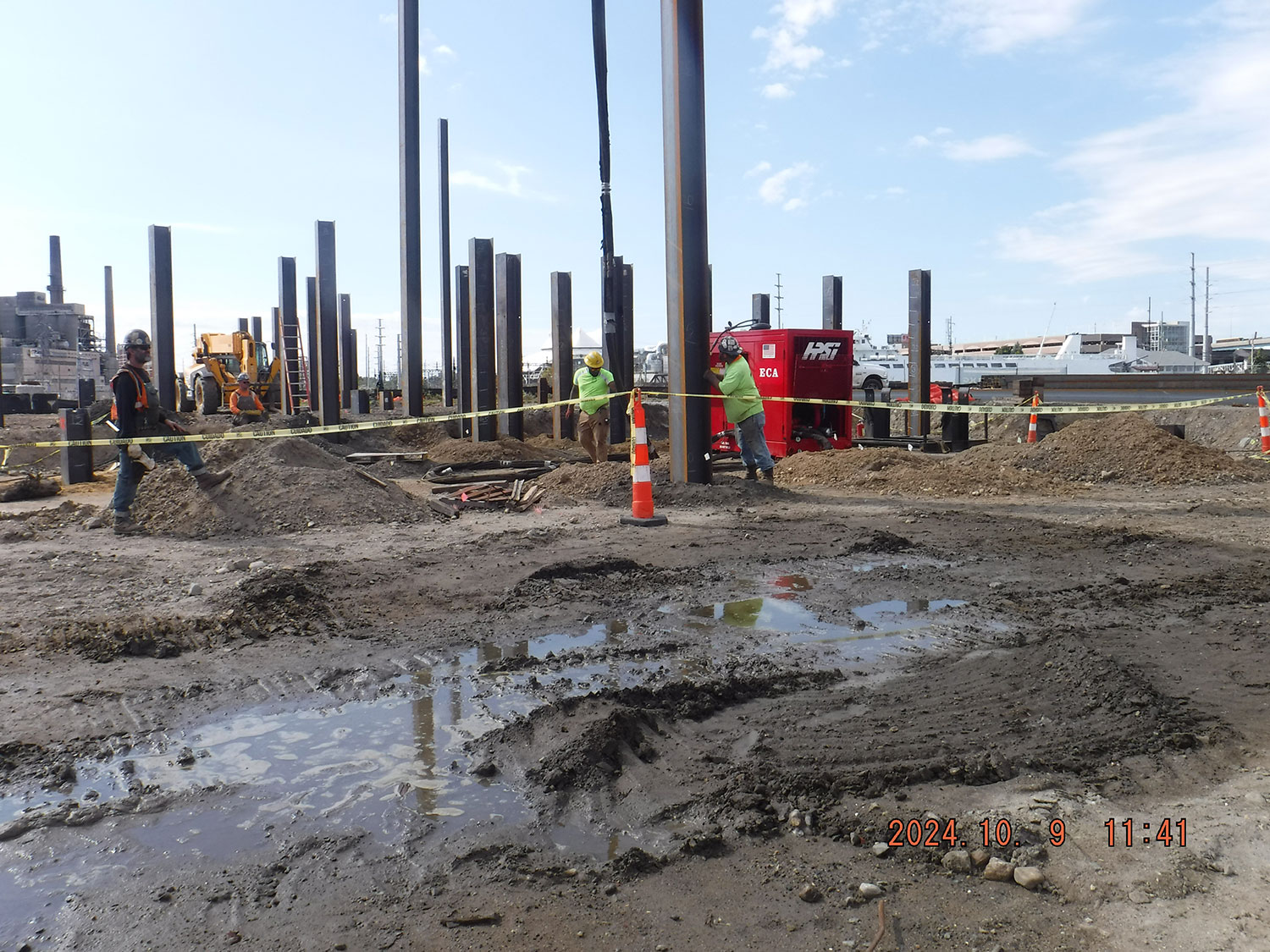
This project has exemplified that with a focused subsurface exploration program, a flexible approach during design, and a bit of ingenuity when unexpected conditions arise; even the most challenging subsurface conditions can be successfully overcome.
Author: Dylan Carlson, Project Engineer, (203) 758-8836